


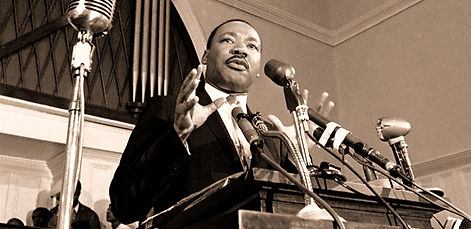
Martin Luther King Jr. Quotes
Technology, Justice, and Moral Formation
“This evening I would like to use this lofty and historic platform to discuss what appears to me to be the most pressing problem confronting mankind today. Modern man has brought this whole world to an awe-inspiring threshold of the future. He has reached new and astonishing peaks of scientific success. He has produced machines that think and instruments that peer into the unfathomable ranges of interstellar space. He has built gigantic bridges to span the seas and gargantuan buildings to kiss the skies. His airplanes and spaceships have dwarfed distance, placed time in chains, and carved highways through the stratosphere. This is a dazzling picture of modern man’s scientific and technological progress.
Yet, in spite of these spectacular strides in science and technology, and still unlimited ones to come, something basic is missing. There is a sort of poverty of the spirit which stands in glaring contrast to our scientific and technological abundance. The richer we have become materially, the poorer we have become morally and spiritually. We have learned to fly the air like birds and swim the sea like fish, but we have not learned the simple art of living together as brothers.
-- Martin Luther King Jr.
“The Quest for Peace and Justice” Nobel Prize Lecture (1964).

"Mammoth productive facilities with computer minds, cities that engulf the landscape and pierce the clouds, planes that almost outrace time - these are awesome, but they cannot be spiritually inspiring. Nothing in our glittering technology can raise man to new heights, because material growth has been made an end in itself, and, in the absence of moral purpose, man himself becomes smaller as the works of man become bigger. Gargantuan industry and government, woven into an intricate computerized mechanism, leave the person outside. The sense of participation is lost, the feeling that ordinary individuals influence important decisions vanishes, and man becomes separated and diminished. When an individual is no longer a true participant, when he no longer feels a sense of responsibility to his society, the content of democracy is emptied. When culture is degraded and vulgarity enthroned, when the social system does not build security but induces peril, inexorably the individual is impelled to pull away from a soul-less society. This process produces alienation-perhaps the most pervasive and insidious development in contemporary society."
-- Martin Luther King Jr.
“Youth and Social Action” (1967).
"Every man lives in two realms, the internal and the external. The internal is that realm of spiritual ends expressed in art, literature, morals, and religion. The external is that complex of devices, techniques, mechanisms, and instrumentalities by means of which we live. Our problem today is that we have allowed the internal to become lost in the external. We have allowed the means by which we live to outdistance the ends for which we live. So much of modern life can be summarized in that arresting dictum of the poet Thoreau: “Improved means to an unimproved end”. This is the serious predicament, the deep and haunting problem confronting modern man. If we are to survive today, our moral and spiritual “lag” must be eliminated. Enlarged material powers spell enlarged peril if there is not proportionate growth of the soul. When the “without” of man’s nature subjugates the “within”, dark storm clouds begin to form in the world.”
-- Martin Luther King Jr.
“The Quest for Peace and Justice,” Nobel Prize Lecture (1964).

“I am convinced that if we are to get on the right side of the world revolution, we as a nation must undergo a radical revolution of values. We must rapidly begin...the shift from a thing-oriented society to a person-oriented society."
"When machines and computers, profit motives and property rights, are considered more important than people, the giant triplets of racism, extreme materialism, and militarism are incapable of being conquered.”
-- Martin Luther King, Jr.
“Beyond Vietnam” (April 1967).
"The means by which we live, have outdistanced the ends for which we live. Our scientific power has outrun our spiritual power. We have guided missiles and misguided man. We have foolishly minimized the internal of our lives and maximized the external. We have absorbed life in livelihood. We will not find peace in our generation until we learn anew that “a man’s life [consists] not in the abundance of the things which he [posses],” but in those inner treasuries of the spirit which “no thief [approaches], neither moth [corrupts].
Without this spiritual and moral reawakening we shall destroy ourselves in the misuse of our own instruments. Our generation cannot escape the question of our Lord: What shall it profit a man, if he gain the whole world of externals—airplanes, electric lights, automobiles, and color television—and lose the internal—his own soul?”
-- Martin Luther King Jr.
“The Man Who Was a Fool” (1963).
Through our scientific and technological genius, we have made of this world a neighborhood and yet we have not had the ethical commitment to make of it a brotherhood. But somehow, and in some way, we have got to do this. We must all learn to live together as brothers or we will all perish together as fools. We are tied together in the single garment of destiny, caught in an inescapable network of mutuality. And whatever affects one directly affects all indirectly. For some strange reason I can never be what I ought to be until you are what you ought to be. And you can never be what you ought to be until I am what I ought to be. This is the way God's universe is made; this is the way it is structured.
-- Martin Luther King Jr.
“Remaining Awake Through a Great Revolution” (1959).

“We must rapidly begin the shift from a thing-oriented society to a person-oriented society. When machines and computers, profit motives and property rights, are considered more important than people, the giant triplets of racism, extreme materialism, and militarism are incapable of being conquered.
A true revolution of values will soon cause us to question the fairness and justice of many of our past and present policies. On the one hand, we are called to play the Good Samaritan on life's roadside, but that will be only an initial act. One day we must come to see that the whole Jericho Road must be transformed so that men and women will not be constantly beaten and robbed as they make their journey on life's highway. True compassion is more than flinging a coin to a beggar. It comes to see that an edifice which produces beggars needs restructuring.”
-- Martin Luther King, Jr.
“The Three Evils of Society” (1967).
Man’s aspirations no longer turned Godward and heavenward. Rather, man's thoughts were confined to man and earth. And man offered a strange parody on the Lord's Prayer: “Our brethren which art upon the earth, Hallowed be our name. Our kingdom come. Our will be done on earth, for there is no heaven." Those who formerly turned to God to find solutions for their problems turned to science and technology, convinced that they now possessed the instruments needed to usher in the new society.
Then came the explosion of this myth. It climaxed in the horrors of Nagasaki and Hiroshima and in the fierce fury of fifty-megaton bombs. Now we have come to see that science can give us only physical power, which, if not controlled by spiritual power, will lead inevitably to cosmic doom. The words of Alfred the Great are still true: "Power is never a good unless he be good that has it." We need something more spiritually sustaining and morally controlling than science. It is an instrument which, under the power of God's spirit, may lead man to greater heights of physical security, but apart from God's spirit, science is a deadly weapon that will lead only to deeper chaos. Why fool ourselves about automatic progress and the ability of man to save himself? We must lift up our minds and eyes unto the hills from whence cometh our true help. Then, and only then, will the advances of modem science be a blessing rather than a curse.
Without dependence on God our efforts turn to ashes and our sunrises into darkest night.
-- Martin Luther King, Jr.
“The Man Who Was a Fool” (1963).
“When machines and computers, profit motives and property rights are considered more important than people, the giant triplets of racism, economic exploitation, and militarism are incapable of being conquered. A civilization can flounder as readily in the face of moral bankruptcy as it can through financial bankruptcy.”
-- Martin Luther King, Jr.
“The Three Evils of Society” (1967).
There are those who seek to convince us that only man is able. Their attempt to substitute a man-centered universe for a God-centered universe is not new. It had its modem beginnings in the Renaissance and subsequently in the Age of Reason, when some men gradually came to feel that God was an unnecessary item on the agenda of life. In these periods and later in the industrial revolution in England, others questioned whether God was any longer relevant. The laboratory began to replace the church, and the scientist became a substitute for the prophet. Not a few joined Swinburne in singing a new anthem: "Glory to Man in the highest for Man is the master of things.”
The devotees of the new man-centered religion point to the spectacular advances of modem science as justification for their faith. Science and technology have enlarged man’s body. The telescope and television have enlarged his eyes. The telephone, radio, and microphone have strengthened his voice and ears. The automobile and airplane have lengthened his legs. The wonder drugs have prolonged his life. Have not these amazing achievements assured us that man is able?
But alas! something has shaken the faith of those who have made the laboratory “the new cathedral of men's hopes.” The instruments which yesterday were worshiped today contain cosmic death, threatening to plunge all of us into the abyss of annihilation. Man is not able to save himself or the world. Unless he is guided by God's spirit, his new-found scientific power will become a devastating Frankenstein monster that will bring to ashes his earthly life.
-- Martin Luther King, Jr.
“Our God is Able” (1963).
"In technology, America has produced mighty bridges to span the seas and skyscraping buildings to kiss the skies. Through the Wright brothers, she has given to the world the airplane and made it possible for man to annihilate distance and circumscribe time. Through medical science, her numerous wonder drugs have cured many dread diseases and greatly prolonged the life of man, America is a great nation, but—That but is a commentary on two hundred and more years of chattel slavery and on twenty million Negro men and women deprived of life, liberty, and the pursuit of happiness. That but stands for a practical materialism that is often more interested in things than values."
-- Martin Luther King, Jr.,
“The Three Dimensions of a Complete Life” (1963).
Some people are rendered unemployable as a result of cybernation and automation. Machines and computers are doing everything now. They will have & system, in fact there was a very interesting thing, even in the schools now, they are using these computers. And a professor decided to give his lecture for the whole year, the whole semester through the computer system and put it on tape recorder. He didn't even go to class. You can see where this cybernation is carrying us to a terrible depersonalization. Bo one day the professor decided to go by to see how the students were making out, and when he got into the class there were no students in there. All he found was a lot of microphones and tape recorders, taping the lecture from the machines.
-- Martin Luther King, Jr.
“Address at Southern Christian Leadership Conference Staff Retreat” (1966).
“The acceptable year of the Lord ( Yes) is that year when men will keep their theology abreast with their technology. The acceptable year of the Lord is that year when men will keep the ends for which they live abreast with the means by which they live.”
-- Martin Luther King Jr.
“Guidelines for a Christian Church” (1966)
Martin Luther King Jr's Philosophy of Technology
Bibliography
Brandon Rickabaugh, PhD
-
King, Martin Luther, Jr., "Paul's Letter to American Christians," delivered at Dexter Avenue Baptist Church, November 1956; published in Strength to Love (1963), 127-134. YouTube
-
King, Martin Luther, Jr., “Remaining Awake Through a Great Revolution,” 1959 Morehouse College commencement address. Stanford MLK Research - YouTube
-
King, Martin Luther, Jr., “What Is the World’s Greatest Need?” New York Times Magazine (April 2, 1961). Reprinted in Clayborne Carson and Tenisha Armstrong (eds.), The Papers of Martin Luther King, Jr.: Volume 7 (University of California Press, 2014). Standford MLK Research
-
King, Martin Luther, Jr., “The Three Dimensions of a Complete Life,” in Martin Luther King, Jr., Strength to Love (Harper & Row, 1963), 83-84. YouTube
-
King, Martin Luther, Jr., “Paul’s Letter to American Christians.” 1963. In Strength to Love, 127-134.
-
King, Martin Luther, Jr., “Address at Southern Christian Leadership Conference Staff Retreat, Frogmore, S.C.,” microfilm, MLKPP, Martin Luther King, Jr. Papers Project, Stanford University (Nov. 14, 1966). Stanford MLK Research
-
King, Martin Luther, Jr., “Impasse in Race Relations,” November 20, 1967, in John Kenneth Galbraith (ed.), The Lost Massey Lectures: Recovered Classics from Five Great Thinkers (United States, Anansi, 2007). YouTube
-
King, Martin Luther, Jr., “Youth and Social Action,” December 4, 1967, in John Kenneth Galbraith (ed.), The Lost Massey Lectures: Recovered Classics from Five Great Thinkers (United States, Anansi, 2007), 193-194.
-
King, Martin Luther, Jr., “Remaining Awake Through a Great Revolution,” delivered at the national Cathedral, Washington, D.C, 31 March 1968, in in Martin Luther King Jr., A Knock at Midnight, edited by Clayborne Carson and Peter Holloran (New York, NY: Warner Books, 1998), 218-219.
-
King, Martin Luther, Jr., “The Quest for Peace and Justice,” Nobel Prize Lecture, University of Oslo, December 11, 1964. From Les Prix Nobel en 1964, Editor Göran Liljestrand, [Nobel Foundation], Stockholm, 1965.
-
King, Martin Luther, Jr., “The Man Who Was a Fool,” in Rev. Dr. Martin Luther King, Jr., A Gift of Love Sermons from Strength to Love and Other Preachings (Boston, MA: Beacon Press, 1963), 77-78.
-
King, Martin Luther, Jr., “Our God is Able,” in Martin Luther King, Jr., Strength to Love (Harper & Row, 1963), 124-125.
-
King, Martin Luther, Jr., “The Three Dimensions of a Complete Life,” in Martin Luther King, Jr., Strength to Love (Harper & Row, 1963), 83-84.
-
King, Martin Luther, Jr., “Guidelines for a Christian Church,” delivered at Ebenezer baptist Church, Atlanta, Georgia (5 JUNE 1966), in Martin Luther King Jr., A Knock at Midnight, edited by Clayborne Carson and Peter Holloran (New York, NY: Warner Books, 1998), 113.
-
King, Martin Luther, Jr., “Address at Southern Christian Leadership Conference Staff Retreat, Frogmore, S.C.,” microfilm, MLKPP, Martin Luther King, Jr. Papers Project, Stanford University (Nov. 14, 1966).
-
King, Martin Luther, Jr., “Beyond Vietnam,” speech delivered at Riverside Church, New York City, April 4, 1967. In C. Carson & P. Holloran (Eds.), A Call to Conscience: The Landmark Speeches of Dr. Martin Luther King, Jr. (pp. 157–158). Warner Books. Standford MLK Research YouTube
-
King, Martin Luther, Jr., “The Three Evils of Society,” Address at the National Conference for New Politics,” Audio Transcript, MLKPP, Martin Luther King, Jr. Papers Project, Stanford University (Aug. 15, 1967).


